

MUDAM (Emma Courtalin): An artistic odyssey in three stages
The Great Hall and Park Dräi Eechelen are the setting for an innovative and evolving exhibition, Waters' Witness, designed by Tarek Atoui. This creation offers a unique sensory approach thanks to a combination of visuals and sounds that take visitors on a journey from Athens to Porto, via Beirut, Abu Dhabi and Singapore. These cities share a common element that unites them: the sea. In order to capture their atmosphere, various disciplines such as history, anthropology and musicology come together. This exhibition retranscribes the human existence and environmental realities of these port cities through sound recordings that capture the murmurs of the sea. In addition to these evocative recordings, the cities are illustrated by characteristic materials, such as marble for Athens. Like the port city, a crossroads of different influences, this immersive exhibition is situated at the intersection of our senses.
"Like the port city, which is a crossroads of different influences, this immersive exhibition is situated at the intersection of our senses."
 "Face-to-Face": a journey through time
 The "Face-à-face" exhibition invites visitors to travel in space and time through several periods that have marked modern art. In this face-to-face exhibition, two collections interact with each other: the modern avant-gardes of early 20th century Germany and France, and contemporary artists from all over the world. A manifestation of plurality, this trans-regional project deals with artistic mutations from the 1920s to the present day, highlighting its moments of rupture. The visitor is immersed in dramatically different universes, through the themes and techniques used, such as photography, sculpture, watercolour, drawing or collage. This artistic odyssey invites us to explore the dark and elusive forest of Emily Bates (The sky is glowing with the setting seun, 2012), to witness a metaphorical duel on a beach created by Beaurin Domercq (Beaurin Domercq, 1998), or to contemplate the melancholy tropics of Janaina Tschäpe (Tristes tropiques II, 2015).
Tacita Dean: between strangeness and familiarity
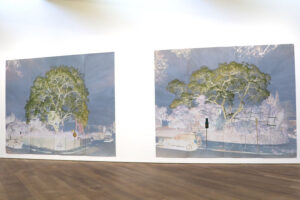
The exhibition presents the works created by Tacita Dean for the ballet 'The Dante Project', choreographed by Wayne McGregor. Through this exhibition, the visitor experiences an artistic immersion in Dante's journey, where each stage is illustrated by a different technique: drawing (for Hell), photography (for Purgatory) and film (for Paradise). A huge chalk drawing on a blackboard representing an inverted mountain range symbolises Hell (Inferno, 2019). Purgatory is represented by photographs of jacarandas (Threshold, 2020). The positive and negative of the latter have been inverted in order to render the foliage of these trees green, instead of the purple that usually characterises them at the arrival of spring. Finally, Paradise is presented in the form of a film (35mn Paradise, 2021), projected in the pavilion, where circular and abstract elements follow one another, making the work hypnotic. A series of lithographs depicting the skies of Los Angeles are exhibited around the pavilion. These colourful and light lithographs contrast with the work of Dante, leaving the visitor with a feeling of familiarity, but also of strangeness.